AI Infrastructure Academy Europe

Understand AI from the data center up — and from the AI application down.

AI is changing the data center.
‍
Not only compute. AI is changing networking, storage, power, cooling, operations, capacity planning and infrastructure economics.
‍

But to understand what infrastructure AI requires, data center professionals first need to understand what modern AI systems are actually doing.
‍
AI Infrastructure Academy Europe is a new monthly masterclass series from High-Tech Connect created specifically for professionals who design, build, operate and manage data center infrastructure.

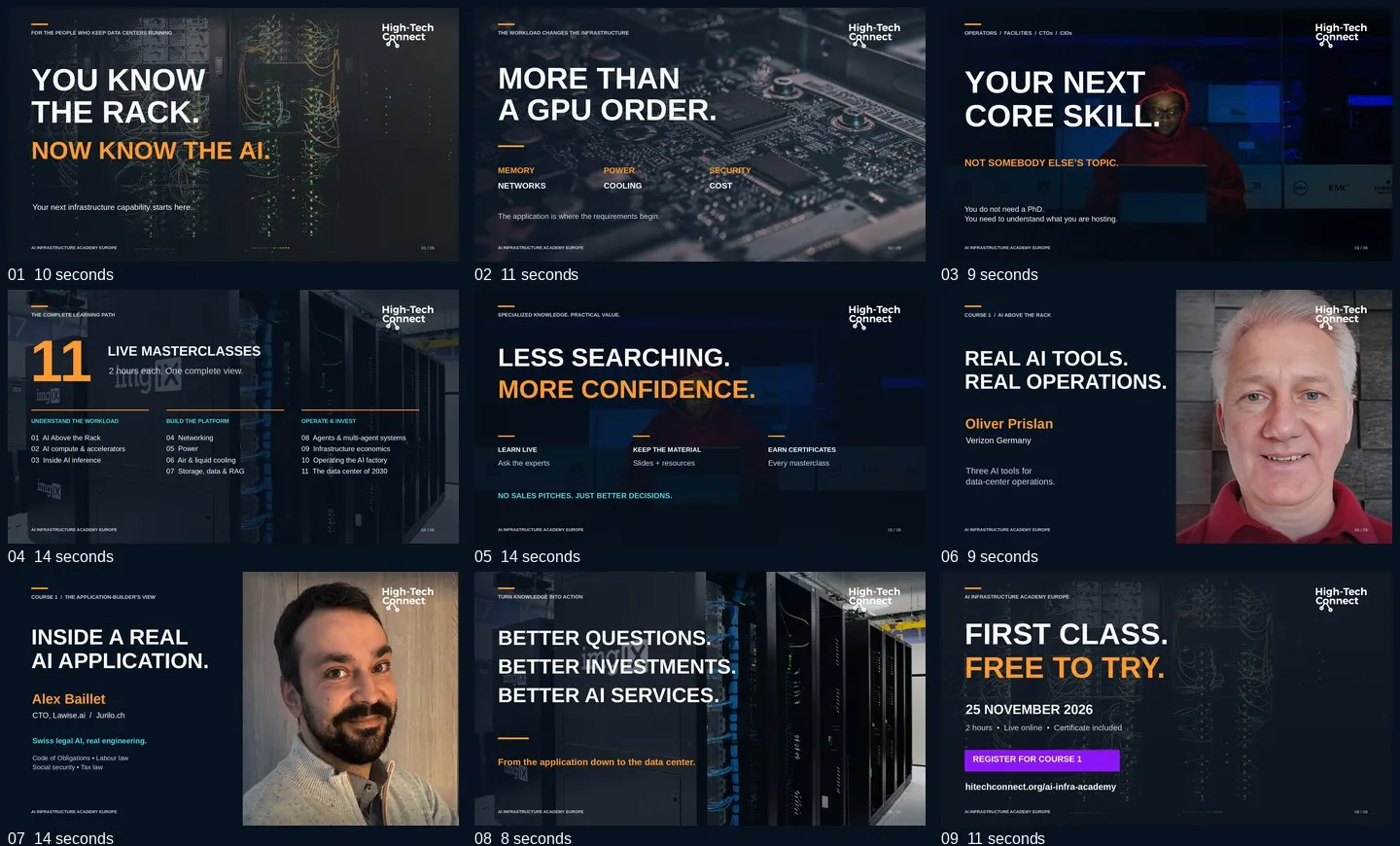
11+1 Live Online Master Classes

2 x 45minutes  each · 2 x 35 minutes teaching + 2 x 10 min Q&A · Certificate included

Why Attend the AI Infrastructure Academy Europe?

10 questions the Academy helps your team answer

Across the Academy, we connect these practical questions with the infrastructure decisions behind them.

1. Which AI customers can we serve—and what should we ask before quoting?

Translate training, inference and enterprise AI requirements into a realistic capacity and service proposition.

2. Can our existing facility become AI-ready without rebuilding everything?

Identify constraints, retrofit options and upgrade priorities across compute, networking, power and cooling.

3. How much AI capacity can we deliver with the power we actually have?

Connect rack density, electrical distribution, UPS, redundancy and operational headroom.

4. When do we need liquid cooling—and what changes operationally?

Compare air and liquid cooling, direct-to-chip systems, CDUs, facility interfaces and maintenance requirements.

5. Why can expensive GPUs sit underused despite strong demand?

Examine memory limits, batching, scheduling, network congestion and data delivery bottlenecks.

6. What makes an AI deployment economically viable?

Understand utilisation, cost per token, energy costs, TCO and cloud-versus-owned infrastructure comparisons.

7. Why can one customer request trigger dozens of model calls?

Show how agents, RAG, long contexts and orchestration change capacity, latency and demand patterns.

8. Will our network and storage keep up with the GPUs?

Explain east-west traffic, RDMA, interconnects, data pipelines, checkpointing and retrieval performance.

9. How do we maintain reliable service in a high-density AI environment?

Cover observability, scheduling, fault handling, maintenance, security and recovery across the infrastructure stack.

10. How do we avoid buying infrastructure that does not fit tomorrow’s workload?

Evaluate accelerators, memory, quantization and deployment choices within an integrated infrastructure roadmap.

Most AI courses start with a model. We start with the whole system.

From the AI application to the physical infrastructure

What happens when somebody asks an AI application a question? Why can one user request trigger 10, 20 or more model calls? What are RAG and AI agents? Why does inference require enormous memory bandwidth? Why is east-west network traffic becoming critical? And what do all these developments mean for rack density, power and cooling?
‍
Every masterclass follows the same principle: AI concept → Workload → Infrastructure Impact → Operator Decision

No previous AI or machine-learning knowledge is required.

1

AI Above the Rack

Wednesday, 25 November 2026

From LLMs and RAG to Agents, Inference and Infrastructure
Agenda - 2 × 45 minutes

1. LLM tools for datacenter operations · 45 min.
Oliver Prislan from Verizon Germany presents three tools his team uses, followed by a 1:1 discussion with Ralf Haller.

2. How to build an AI application · 45 min.
Alex Baillet, CTO of Lawise.ai, shows how to build an AI application, followed by a 1:1 discussion with Ralf Haller.
‍

10 topics covered

    • How modern AI applications work: from user requests to model execution.
    • Foundation models, LLMs and the difference between training and inference.
    • Tokens, context windows and why they determine compute and memory demand.
    • Retrieval-Augmented Generation (RAG) and enterprise data access.
    • AI agents, tools, orchestration and multi-agent systems.
    • Why a single AI request can generate dozens of inference calls.
    • AI gateways, model routing, APIs and application infrastructure.
    • Mapping AI workloads to GPUs, memory, networking and storage.
    • Implications for rack density, power, cooling and data-center operations.
    • How to assess whether existing infrastructure can support AI workloads.

Operator takeaway

Understand what actually runs on AI infrastructure before making hardware or facility investments.

Learning format

Technical explanation and real-world examples, followed by an applied infrastructure decision exercise and live Q&A.

A 2 x 45-minute introduction to the architecture of modern AI systems and what it means for the infrastructure underneath.
‍
You will understand LLMs, inference, RAG, AI agents, model calls, context, AI gateways and the basic architecture of an AI application — before following the workload down into compute, memory, networking, storage, power and cooling.

The ideal starting point for the entire Academy.

REGISTER FREE

2

AI Compute: GPUs, TPUs & Inference Accelerators

Wednesday, 27 January 2027

Choosing and sizing AI compute

10 topics covered

    • Why AI requires different compute architectures from conventional enterprise IT.
    • CPUs versus GPUs, TPUs and dedicated AI accelerators.
    • GPU architecture: parallel execution, tensor cores and compute throughput.
    • High Bandwidth Memory (HBM): capacity, bandwidth and bottlenecks.
    • Training versus inference: different infrastructure requirements.
    • NVIDIA/CUDA and alternative AI hardware and software ecosystems.
    • Multi-GPU servers, scale-up interconnects and accelerator clusters.
    • GPU utilization, scheduling, virtualization and resource sharing.
    • Server power consumption, thermal design and rack-density implications.
    • Selecting accelerators based on workload, performance, energy and total cost.

Operator takeaway

Choose and size AI compute platforms based on actual workloads rather than accelerator specifications alone.

Learning format

Technical explanation and real-world examples, followed by an applied infrastructure decision exercise and live Q&A.

What makes AI compute different from conventional server workloads?

We examine GPUs, TPUs and specialized AI accelerators, training versus inference, memory bandwidth, HBM, utilization and the increasingly heterogeneous AI compute landscape.

Key question: Which compute architectures are suited to which AI workloads?

REGISTER FREE

3

Inside AI Inference

Wednesday, 24 February 2027

Performance, latency and capacity

10 topics covered

    • How inference works: prefill, token generation and model execution.
    • Time to First Token (TTFT), output token throughput and end-to-end latency.
    • Context length and its effects on memory use and processing time.
    • KV cache: why memory capacity and bandwidth matter.
    • Continuous batching and the trade-off between throughput and latency.
    • Quantization and model compression: performance, memory and accuracy.
    • Model serving software and inference runtime architectures.
    • Concurrent users, request queues, peak loads and capacity planning.
    • Inference benchmarks: measuring performance under realistic workloads.
    • Designing an on-premises inference service with predictable service levels.

Operator takeaway

Estimate the infrastructure required to serve AI users with acceptable latency and cost.

Learning format

Technical explanation and real-world examples, followed by an applied infrastructure decision exercise and live Q&A.

What actually happens when a model generates an answer?

Understand tokens, context windows, time to first token (TTFT), tokens per second (TPS), batching, KV cache, quantization and other fundamentals of inference.

Then connect them directly to infrastructure requirements.

Key question: What determines the performance and infrastructure cost of an AI request?

REGISTER FREE

4

AI Networking: The New East-West Traffic Problem

Wednesday, 31 March 2027

Networks as part of the compute system

10 topics covered

    • How AI training and inference workloads generate network traffic.
    • North-south versus east-west traffic in AI infrastructure.
    • Scale-up and scale-out networks: where each is required.
    • Ethernet, InfiniBand and specialized accelerator interconnects.
    • Bandwidth, latency, jitter and congestion in distributed AI systems.
    • RDMA, RoCE and high-performance data transfers.
    • GPU-to-GPU communication and collective operations.
    • Leaf-spine fabrics, oversubscription and network topology design.
    • Network monitoring, congestion management and fault isolation.
    • Designing AI-ready network upgrades for existing data centers.

Operator takeaway

Identify when conventional networking suffices and when AI needs a different fabric.

Learning format

Technical explanation and real-world examples, followed by an applied infrastructure decision exercise and live Q&A.

AI systems can create enormous communication requirements between accelerators, servers and clusters.

We examine scale-up versus scale-out networks, Ethernet, InfiniBand, bandwidth, latency, congestion and distributed AI workloads.

Key question: Why is the network becoming part of the AI compute system?

REGISTER

5

Powering the AI Data Center

Wednesday, 28 April 2027

Electrical capacity and resilience

10 topics covered

    • AI server power profiles and their impact on facility design.
    • Rack power density: from conventional IT to high-density AI racks.
    • Power distribution: transformers, switchgear, PDUs and busways.
    • UPS systems, battery technologies and backup power requirements.
    • Power redundancy, availability tiers and failure scenarios.
    • Dynamic AI loads, transient behavior and power quality.
    • Grid connections, utility capacity and long lead times.
    • Electrical capacity planning for phased AI infrastructure growth.
    • Power monitoring, energy efficiency, PUE and operational optimization.
    • Retrofitting an existing data center for high-density AI equipment.

Operator takeaway

Assess electrical readiness and plan upgrades for AI infrastructure.

Learning format

Technical explanation and real-world examples, followed by an applied infrastructure decision exercise and live Q&A.

AI is dramatically changing the power profile of the data center.

We examine rack density, power distribution, UPS requirements, utilization, redundancy, grid constraints and the relationship between AI workload growth and facility capacity.

Key question: How do you plan power infrastructure when AI demand can grow faster than the facility?

REGISTER

6

Cooling AI: From Air to Liquid

Wednesday, 26 May 2027

Thermal design for high-density compute

10 topics covered

    • How AI compute density translates into thermal loads.
    • Limits of conventional air cooling for high-density racks.
    • Hot-aisle/cold-aisle containment and airflow optimization.
    • Rear-door heat exchangers and hybrid cooling approaches.
    • Direct-to-chip liquid cooling: architecture and operating principles.
    • Coolant Distribution Units (CDUs), facility water loops and heat exchangers.
    • Single-phase versus two-phase liquid cooling and immersion approaches.
    • Water quality, leak detection, maintenance and operational risks.
    • Cooling efficiency, water usage, heat reuse and sustainability.
    • Planning a phased migration from air cooling to liquid cooling.

Operator takeaway

Evaluate appropriate cooling architectures for current and future AI rack densities.

Learning format

Technical explanation and real-world examples, followed by an applied infrastructure decision exercise and live Q&A.

Increasing compute density creates increasing heat density.

Understand the move from traditional air cooling toward rear-door heat exchangers, direct-to-chip liquid cooling, CDUs and high-density thermal architectures.

Key question: At what point does conventional cooling stop being enough?

REGISTER

7

AI Storage, Data & RAG Infrastructure

Wednesday, 30 June 2027

Enterprise data near the model

10 topics covered

    • Why AI applications need data infrastructure beyond the model itself.
    • Data ingestion, preparation, indexing and AI data pipelines.
    • Object, block and file storage for AI workloads.
    • Storage throughput, IOPS, latency and data-access patterns.
    • Embeddings and vector databases: how semantic search works.
    • RAG architecture and its infrastructure requirements.
    • Knowledge graphs and Graph RAG for connected enterprise information.
    • Data locality: keeping sensitive enterprise data close to AI compute.
    • Data governance, access controls, encryption and backup strategies.
    • Designing an on-premises enterprise AI knowledge infrastructure.

Operator takeaway

Plan enterprise AI storage and data services without performance or governance bottlenecks.

Learning format

Technical explanation and real-world examples, followed by an applied infrastructure decision exercise and live Q&A.

AI doesn't operate on models alone. It needs data.

We examine RAG, vector databases, knowledge graphs, embeddings, data pipelines, storage throughput and data locality — and how these components interact with inference infrastructure.

Key question: What happens between enterprise data and the model?

REGISTER

8

Agentic AI & Multi-Agent Infrastructure

Wednesday, 28 July 2027

Infrastructure for autonomous workflows

10 topics covered

    • AI assistants versus autonomous and semi-autonomous AI agents.
    • The agent loop: planning, acting, observing and evaluating.
    • Tool calling, APIs and connections to enterprise systems.
    • Multi-agent architectures and orchestration frameworks.
    • Sequential versus parallel agent execution.
    • Workload amplification: why one request may trigger many model calls.
    • Bursty inference demand, concurrency and capacity planning.
    • Agent memory, context management and intermediate storage.
    • Reliability, timeouts, retries, permissions and security controls.
    • Hosting agentic AI reliably in enterprise and private-cloud environments.

Operator takeaway

Engineer capacity and reliability for agentic AI workloads.

Learning format

Technical explanation and real-world examples, followed by an applied infrastructure decision exercise and live Q&A.

The next generation of AI applications doesn't simply answer questions. It plans, uses tools, calls other systems and delegates work to other agents.

One user request can therefore become many model calls.

We examine agent loops, orchestration, tool use, multi-agent architectures, retries and workload amplification.

Key question: What happens to infrastructure demand when one request becomes 20?

REGISTER

9

AI infrastructure Economics

Wednesday, 25 August 2027

Total cost and workload placement

10 topics covered

    • Capital expenditure versus operating expenditure for AI infrastructure.
    • GPU acquisition, depreciation, maintenance and refresh cycles.
    • Measuring accelerator utilization and idle capacity.
    • Cost per token, cost per request and cost per active user.
    • The economics of large versus smaller AI models.
    • Batching, caching and quantization as cost optimization techniques.
    • Model routing and workload placement across different accelerators.
    • Energy costs, cooling overhead and performance per watt.
    • On-premises versus colocation versus cloud inference economics.
    • Building a total-cost-of-ownership and ROI model for enterprise AI.

Operator takeaway

Evaluate the business case for hosting AI workloads privately.

Learning format

Technical explanation and real-world examples, followed by an applied infrastructure decision exercise and live Q&A.

AI performance is only half of the problem. The other half is economics.
‍
We examine accelerator utilization, model size, tokens, batching, caching, quantization, model routing, specialized inference hardware and performance per watt.
‍
Key question: How do you reduce the cost of inference without destroying performance or quality?

REGISTER

10

Operating the AI Factory

Wednesday, 29 September 2027

Reliability, security and operations

10 topics covered

    • The operational architecture of a production AI infrastructure platform.
    • Kubernetes, GPU orchestration and workload scheduling.
    • Multi-tenancy, resource quotas and accelerator allocation.
    • Monitoring GPU, CPU, memory, storage, network, power and cooling.
    • AI observability: model latency, token throughput, errors and traces.
    • Capacity management, scaling and workload prioritization.
    • Security, identity, isolation and data-protection requirements.
    • Model deployment, versioning, upgrades and rollback.
    • High availability, incident response and disaster recovery.
    • Defining operational KPIs and service-level objectives for AI infrastructure.

Operator takeaway

Operate AI infrastructure as a reliable enterprise service.

Learning format

Technical explanation and real-world examples, followed by an applied infrastructure decision exercise and live Q&A.

Production AI needs much more than accelerators.
‍
We examine orchestration, observability, monitoring, scheduling, reliability, security, guardrails, evaluation, failure recovery and the operational stack around production AI.
‍
Key question: How do you operate AI infrastructure reliably rather than merely get a demo running?

REGISTER

11

Designing the AI Data Center of 2030

Wednesday, 27 October 2027

An integrated investment roadmap

10 topics covered

    • How future AI applications could change data-center workload demand.
    • Trends in accelerator architectures and heterogeneous computing.
    • Future memory, interconnect and network requirements.
    • Modular and scalable AI data-center architectures.
    • High-density racks, liquid cooling and thermal infrastructure planning.
    • Grid constraints, energy availability and alternative power strategies.
    • Edge AI, distributed inference and regional AI infrastructure.
    • Sovereign AI, data residency and private enterprise AI.
    • Designing flexible infrastructure under technological uncertainty.
    • Creating a practical three-to-five-year AI infrastructure investment roadmap.

Operator takeaway

Develop a realistic roadmap while avoiding premature infrastructure investments.

Learning format

Technical explanation and real-world examples, followed by an applied infrastructure decision exercise and live Q&A.

The final masterclass brings the complete Academy together.
‍
Compute. Memory. Networking. Storage. Power. Cooling. Operations. Economics.
‍
We connect them into one system and examine how increasingly powerful inference, agentic AI and new accelerator architectures could influence the next generation of data centers.
‍
Key question: What should data center operators be preparing for now?

REGISTER

Designed for Data Center Professionals

The Academy is designed for professionals working across:

Data Center Operations · Facility Management · IT Infrastructure · Cloud & Platform Infrastructure · Data Center Engineering · Networking · Power & Energy · Cooling · Infrastructure Architecture · Technical Management

You do not need to be an AI engineer.

The objective is to give infrastructure professionals enough understanding of AI systems to make better infrastructure decisions.

One Masterclass. One Topic. 2 x 45 Minutes.

Each session is deliberately compact.

2 x 35 minutes — focused technical masterclass
2 x 10 minutes — live Q&A

No day-long seminar. No generic AI introduction. No unnecessary theory.
Each session connects an AI technology directly to its real-world data center implications.
‍
All sessions are delivered live online.

Certificates

Participants receive a High-Tech Connect Certificate of Completion for every masterclass attended.

Participants completing at least 8 of the 11 masterclasses receive the:

AI Infrastructure Academy Europe Certificate

High-Tech Connect

This provides a structured learning path while allowing participants to select only the subjects relevant to their work.

JOIN HIGH-TECH CONNECT

Pricing

Individual Masterclass

Full 11-Class Academy

Standard

Free

Free

HTC Community & partner members

Free

Free

Certificate

Included

Included

Live Q&A

Included

Included

Presentation slides & supporting materials

Included

Included

Keep the knowledge. Put it to work.

Every masterclass includes downloadable presentation slides and supporting materials - valuable resources to revisit, deepen your understanding and apply what you learn to your own Al infrastructure projects.

High-Tech Connect Community and partner members save 50% for events.

Not yet part of the community?

REGISTER FOR THE ACADEMY

The Datacenter Expert Team

Ralf Haller
President High-Tech Connect
Stefan Baumann
Director Operations at NorthC
Oliver Prislan
Manager Network Planning & Energy at Verizon Germany
Amin Loukil
Business Continuity Manager ex-Digital Realty