



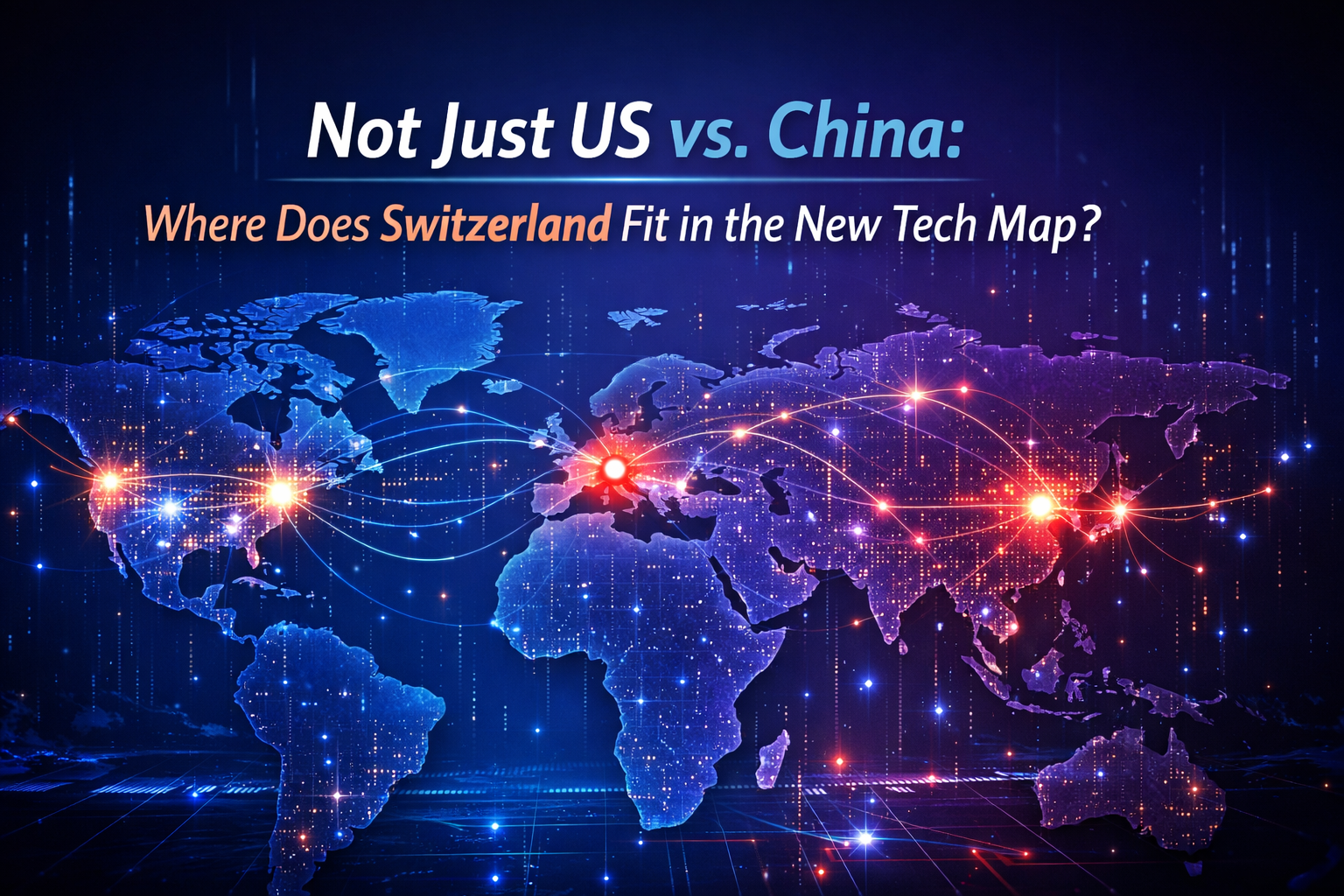
In the global tech debate, the narrative is often reduced to a simple rivalry: the United States versus China.
One leads in foundational models, venture capital, and platforms.
The other leads in scale, industrial deployment, and speed.
But in his book The New Geography of Innovation, Mehran Gul argues that this framing is too narrow. The future of technology will not be defined by just two superpowers. Instead, it will be shaped by a multipolar landscape of specialized innovation ecosystems—each with its own culture, strengths, and structural constraints.
For countries like Switzerland and regions like Europe, this is both a reassuring message and a warning.
The Core Idea: Innovation Is Becoming Multipolar
Gul’s central thesis is simple:
The future of technology will be shaped by multiple regional hubs, not just Silicon Valley and China.
Different places succeed for different reasons:
- The US dominates in breakthrough technologies and venture-backed startups.
- China dominates in scale, speed, and industrial deployment.
- Other regions—like Switzerland, Singapore, London, and South Korea—excel in specialized niches.
There is no single “Silicon Valley formula” that can be copied.
Innovation ecosystems are shaped by:
- Culture
- Capital markets
- Risk tolerance
- Immigration
- Market size
- Government policy
Where Switzerland Appears in the Book
Switzerland is presented as a distinct innovation model, shaped by its culture, institutions, and history.
Switzerland as a High-Trust, Privacy-Driven Tech Culture
One of Gul’s most telling examples relates to Switzerland’s COVID contact-tracing system.
(Remark: which btw did definitely not work at all, but some university got nicely paid still.)
He highlights how the Swiss system was designed around privacy and decentralization, using Bluetooth rather than centralized government databases. This reflected Switzerland’s long tradition of:
- Neutrality
- Discretion
- Trust
- Strong privacy norms
Key Switzerland-related quotes and ideas from the book
Here are the core points Gul makes about Switzerland:
- Technology reflects national culture
Switzerland’s emphasis on privacy and decentralization is not accidental—it grows out of its political and financial traditions.
- Switzerland excels at specialized, high-quality innovation
The country is strong in:
- Research
- Precision industries
- Niche technologies
- Deep engineering
- But Switzerland is not a scale tech power
Structural factors limit its ability to produce global tech giants:
- Small domestic market
- Conservative capital culture
- Lower tolerance for failure
In Gul’s framework, Switzerland is:
A highly respected, high-quality innovation hub—but not a global tech superpower.
The Bigger Picture: Different Regions, Different Roles
Gul sees the global tech landscape evolving into distinct innovation roles.
The future is not one winner.
It is a network of specialized innovation centers.

The future is not one winner. It is a network of specialized innovation centers.
How This Compares to the High-Tech Connect Thesis
At first glance, Gul’s argument sounds optimistic for Europe and Switzerland.
If the future is multipolar, then everyone has a role.
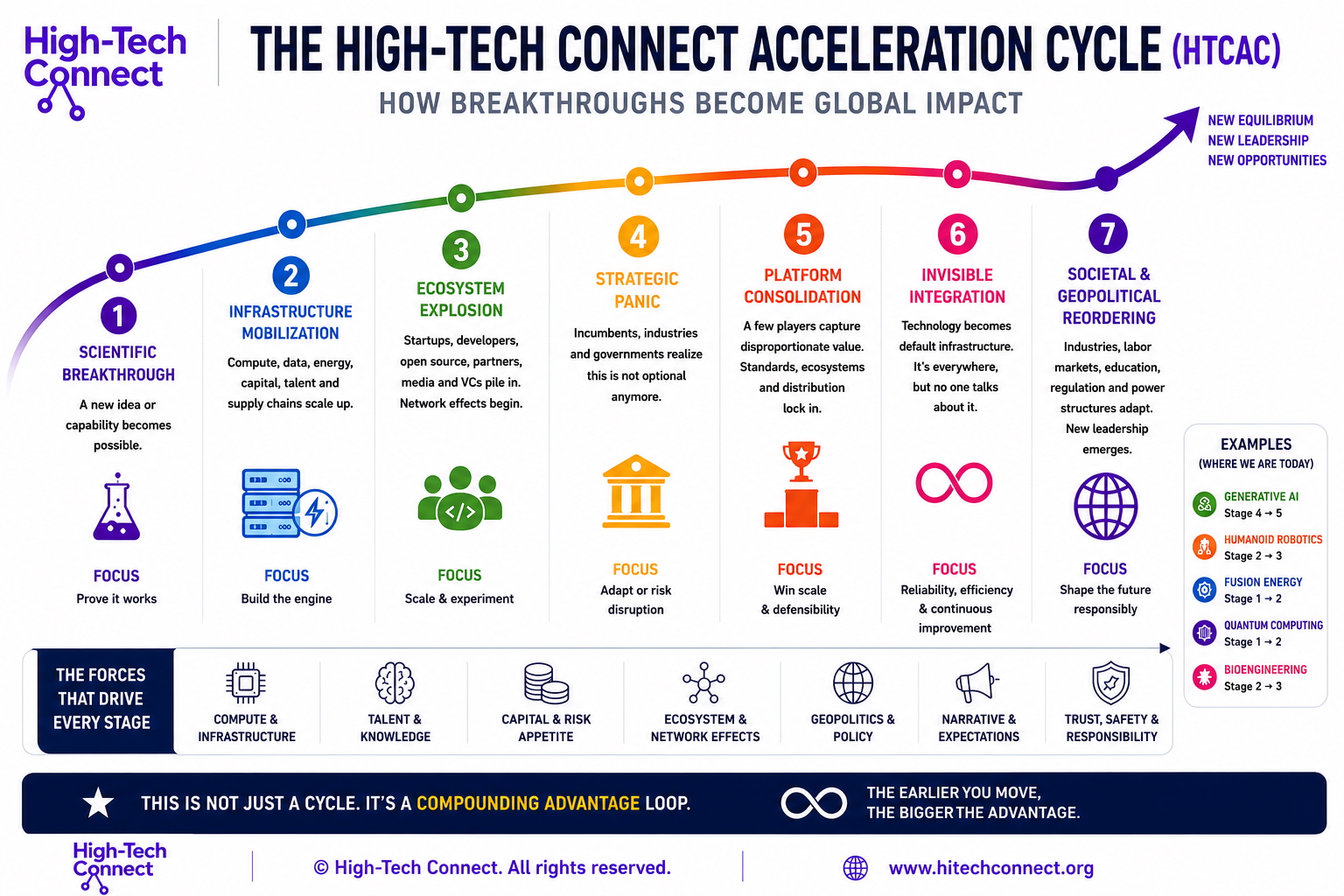
But this is exactly where the High-Tech Connect perspective diverges.
1) Gul: Multipolar innovation is the new normal
He argues:
- The world is no longer dominated by one or two tech centers.
- Many regions can succeed in different niches.
High-Tech Connect: Scale still determines global impact
The core thesis has been:
- The biggest economic value comes from platform-scale technologies.
- These tend to emerge where:
- Capital is abundant
- Risk tolerance is high
- Markets are large
- Talent is global
So while Europe and Switzerland may excel in niches, they:
- Rarely produce global tech champions
- Often become customers of US or Chinese platforms
- Miss entire technology waves
2) Gul: Culture shapes innovation strengths
Gul emphasizes:
- Switzerland’s privacy culture leads to privacy-centric tech.
- Each region has its own innovation style.
High-Tech Connect: Culture also creates structural limits
The argument has been sharper:
- Europe’s risk aversion
- Conservative capital markets
- Regulatory mindset
- Focus on consensus over speed
These factors don’t just shape innovation—they constrain it.
So while Gul sees cultural differences as neutral or even positive, the High-Tech Connect thesis suggests:
Some cultures produce global tech leaders. Others produce excellent but local or niche solutions.
3) Gul: Specialized roles are a valid outcome
In his view:
- Not every region needs to produce the next Apple or Google.
- Specialized excellence is a legitimate position.
High-Tech Connect: Specialization alone is risky
Ths perspective is more strategic.
If Europe only plays niche roles, it risks:
- Losing strategic autonomy
- Becoming dependent on foreign platforms
- Missing out on the largest economic value pools
This is why High-Tech Connect pushes for:
- Earlier enterprise investment in startups
- More risk-tolerant capital
- Stronger tech-startup-enterprise partnerships
What the Book Gets Right About Switzerland
Gul’s portrayal of Switzerland is largely accurate:
Strengths:
- World-class research (ETH, EPFL)
- Precision engineering culture
- High trust society
- Strong privacy and security mindset
- Specialized industrial excellence
Limitations:
- Small domestic market
- Conservative venture culture
- Few global tech platforms
- Slow scaling of startups
This aligns closely with the observations behind Silicon Valley Meets Switzerland.
The Real Question for Switzerland
Gul’s book implicitly asks:
Is it enough for Switzerland to be a specialized innovation hub?
Or should it aim to:
- Build global technology leaders
- Invest earlier in frontier startups
- Compete in platform-scale markets
This is exactly the debate at the core of the High-Tech Connect events.
Why This Matters Now
In AI, quantum, robotics, and next-generation compute:
- The US is moving fast.
- China is scaling aggressively.
- Europe is still debating regulation and funding models.
If Gul is right, Switzerland will remain a respected innovation hub.
If the High-Tech Connect thesis is right, that may not be enough to stay economically competitive in the next wave.
A Question for Swiss Leaders
If the future of tech is multipolar:
- What role does Switzerland want to play?
- Precision supplier?
- Trusted niche innovator?
- Or builder of global tech champions?
That is not a cultural question.
It is an investment and leadership decision.













.jpg)


.jpg)


