




Based on a New York Times Opinion roundtable
Artificial intelligence has moved from research labs to dinner-table conversations in just a few years. According to a recent The New York Times Opinion roundtable, even experts who work on AI every day disagree sharply about what comes next. But beneath the differences, a few clear themes emerge.
Below is a synthesis of the discussion among eight AI researchers, entrepreneurs, economists, and policy thinkers about where AI is heading in the next five years.
1) AI Will Be Everywhere — But Not Magic
One of the strongest points of agreement is that AI will become deeply embedded in daily life. Nick Frosst, co-founder of Cohere, predicts that AI will become “boring in the best way,” fading into the background like GPS or spreadsheets.
But several experts push back against the idea that today’s systems represent human-like intelligence.
- Gary Marcus argues that large language models are “superficial and unreliable.”
- Melanie Mitchell says conversational ability is not a sign of true intelligence.
- Many participants say artificial general intelligence (AGI) is unlikely within a decade.
Bottom line: AI will be widespread and useful, but not close to human-level intelligence across the board.
2) The Biggest Impacts Will Be Uneven
Across sectors, the panel expects very different timelines and effects.
Programming: Large and immediate impact
Most experts agree that coding is one of the most AI-friendly fields because it is purely digital.
Carl Benedikt Frey notes that developers complete tasks more than 50% faster with AI tools, although human review is still required.
Medicine: Helpful, but not revolutionary (yet)
Some predict major breakthroughs, but others are skeptical.
- Gary Marcus says most real-world impact so far is limited to note-taking.
- Frosst expects AI to make doctors more efficient, not replace them.
- Few believe AI will autonomously invent new drugs in the near term.
Scientific research: Promising but slower than hype
Mitchell points out that AI still struggles with core scientific tasks like asking the right questions or designing experiments.
3) Productivity Gains Alone Won’t Create Prosperity
One of the more subtle but important points comes from economist Carl Benedikt Frey.
He argues that:
- Simply automating existing tasks leads to cheaper versions of the same output.
- Real economic growth comes from entirely new industries.
He compares AI productivity tools to improved looms: they made cloth cheaper, but didn’t transform the economy the way new industries did.
Implication: The biggest value of AI will come from new business models, not just automation.
4) Education, Work, and Mental Health Will Be Disrupted
Several experts see the social impact as more uncertain than the technical one.
Education
- Some believe AI tutors could outperform many human teachers.
- Others say AI is already undermining traditional assignments like term papers.
Jobs
Opinions diverge on whether AI will increase unemployment.
But most agree work will change significantly rather than disappear entirely.
Mental health
Yuval Noah Harari warns that the AI transition could trigger a global psychological crisis as societies struggle to adapt.
5) The Real Risks Are Social and Political
The panel is split on technical risks, but several agree that AI will likely play a role in major global security events by 2030.
Others highlight more subtle risks:
- People believing AI systems are conscious when they are not.
- Overreliance on AI in education or mental health.
- Rapid automation accelerating AI development itself.
Ajeya Cotra suggests that AI companies may automate their own operations, potentially speeding up progress dramatically.
6) Personal AI Assistants May Become the Main Interface
Aravind Srinivas, CEO of Perplexity, predicts a future where people have highly personal AI assistants that work privately for them.
In this view, AI becomes:
- A daily companion
- A knowledge interface
- A personalized tool, not a centralized service
Several experts also believe most people will use AI chatbots daily by 2030.
7) No Consensus on AGI
Perhaps the most striking takeaway is how little agreement there is on artificial general intelligence.
- Some say AGI is very likely within 10 years.
- Others say it’s unlikely even in 50 years.
- Some dismiss the concept as poorly defined.
Even among top experts, the timeline for human-level AI remains deeply uncertain.
The Core Insight: AI Is a Tool, an Agent, and a Social Shock
Across all viewpoints, three themes stand out:
- AI will be ubiquitous within five years.
- Its economic impact depends on new industries, not just automation.
- The biggest disruptions will be social, educational, and psychological.
Or as Yuval Noah Harari puts it, humanity may be entering the largest psychological experiment in history — without knowing the outcome.
What This Means for Enterprises and Startups
For companies, the message is surprisingly pragmatic:
- Don’t wait for AGI.
- Focus on real productivity gains.
- Build new products and industries around AI.
- Prepare for organizational and cultural change.
The future of AI will likely be less about sci-fi breakthroughs — and more about slow, uneven, but very real transformation across every sector.
Here are the eight experts from the The New York Times AI roundtable, each with a one-sentence introduction and a relevant official or primary website.
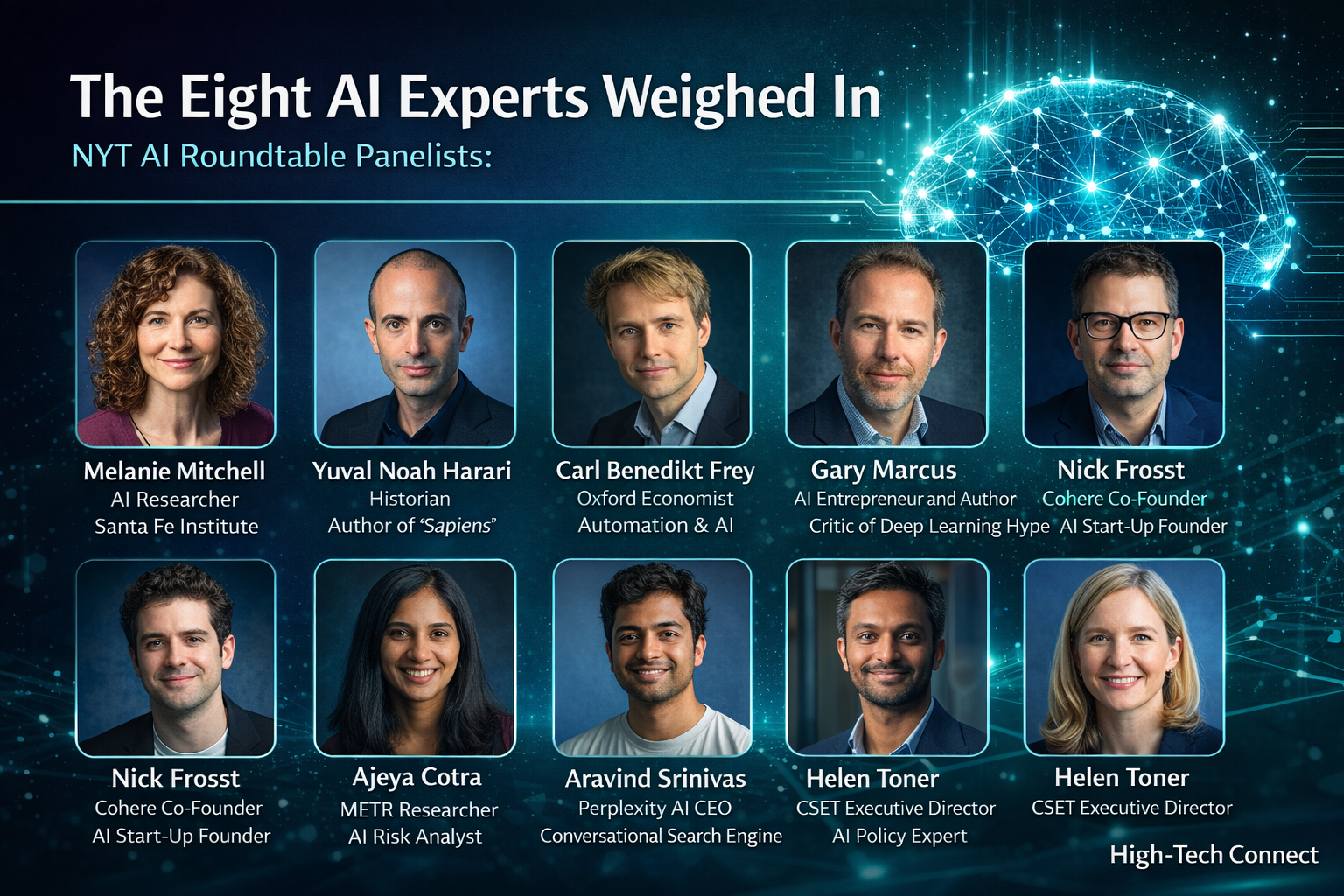
Melanie Mitchell
Computer scientist at the Santa Fe Institute known for research on AI, complexity, and the limits of current machine learning systems.
Website: https://melaniemitchell.me
Yuval Noah Harari
Historian and bestselling author (e.g., Sapiens) who analyzes the societal, political, and philosophical implications of AI.
Website: https://www.ynharari.com
Carl Benedikt Frey
Oxford economist studying automation, AI, and the future of work, known for research on how technology reshapes labor markets.
Website: https://www.oxfordmartin.ox.ac.uk/people/carl-benedikt-frey/
Gary Marcus
AI researcher, entrepreneur, and critic of deep-learning hype, focused on building more reliable and reasoning-based AI systems.
Website: https://garymarcus.com
Nick Frosst
Co-founder of the AI company Cohere and former Google Brain researcher working on practical large-scale AI systems.
Website: https://cohere.com
Ajeya Cotra
AI risk analyst at the nonprofit METR, known for research on long-term AI development timelines and societal impacts.
Website: https://metr.org
Aravind Srinivas
Co-founder and CEO of Perplexity, an AI-driven search company building conversational knowledge assistants.
Website: https://www.perplexity.ai
Helen Toner
AI policy researcher and executive director at Georgetown’s Center for Security and Emerging Technology, focusing on governance and global AI competition.
Website: https://cset.georgetown.edu













.jpg)


.jpg)


