




What we saw at the NVIDIA GTC was not a typical product keynote.
It was a clear signal: AI is no longer a technology wave. AI is now an industry.
And that industry is being built right now—at a speed and scale rarely seen, even by Silicon Valley standards.
1. From Data Centers to “AI Factories”
Jensen Huang introduced a concept that will define the next decade:
AI Token Factories
The shift is profound:
- Data centers used to produce compute
- Now they produce AI tokens (inference, decisions, outputs)
This changes everything:
- Value is no longer in training alone
- It’s in continuous operation and usage of AI
👉 AI becomes comparable to:
- electricity
- cloud infrastructure
- global networks
A new industrial layer of the economy is forming.
2. Infrastructure at Trillion-Dollar Scale
With next-generation platforms like Vera Rubin, the message is clear:
- AI infrastructure investment is moving toward the trillion-dollar range
- Hyperscalers, governments, and enterprises are building capacity simultaneously
- Demand is not speculative—it is already contracted and committed
👉 This matters:
We are no longer in an “AI hype cycle.”
We are in a global build-out phase, similar to:
- the internet
- the cloud
- the power grid
3. NVIDIA Is Becoming the Operating System of AI
NVIDIA is no longer just a chip company.
It now controls the full stack:
- chips (GPUs)
- software (CUDA, NeMo)
- models and frameworks
- simulation (Omniverse)
- networking
👉 Strategically, this is massive:
NVIDIA is becoming what:
- Microsoft was for software
- Amazon became for cloud
A vertically integrated operating system for artificial intelligence.
4. AI Agents Are Now a Commodity
With platforms like NeMo, the barrier to building AI agents is effectively gone:
- standardized infrastructure
- enterprise-grade security
- scalable deployment
👉 The competitive landscape shifts:
❌ Not: “Who can build AI?”
✅ But: “Who has the best data, workflows, and distribution?”
For companies, this means:
The excuse “we don’t know how to start” is no longer valid.
5. Physical AI Is Real - and Next
One of the most important signals from the keynote:
AI is leaving the screen.
Applications include:
- robotics
- autonomous vehicles
- industrial automation
With simulation environments (like Omniverse), a new paradigm emerges:
What works in simulation increasingly works in reality.
👉 This is potentially bigger than generative AI:
- manufacturing
- logistics
- infrastructure
- defense
The physical world is becoming programmable.
6. The Quiet Shift: Capital Reallocation
At the same time, we see a parallel trend:
Meta is reducing headcount while aggressively investing in AI infrastructure.
👉 The pattern is clear:
- capital is shifting from people → machines
- from Opex → Capex
- from services → systems
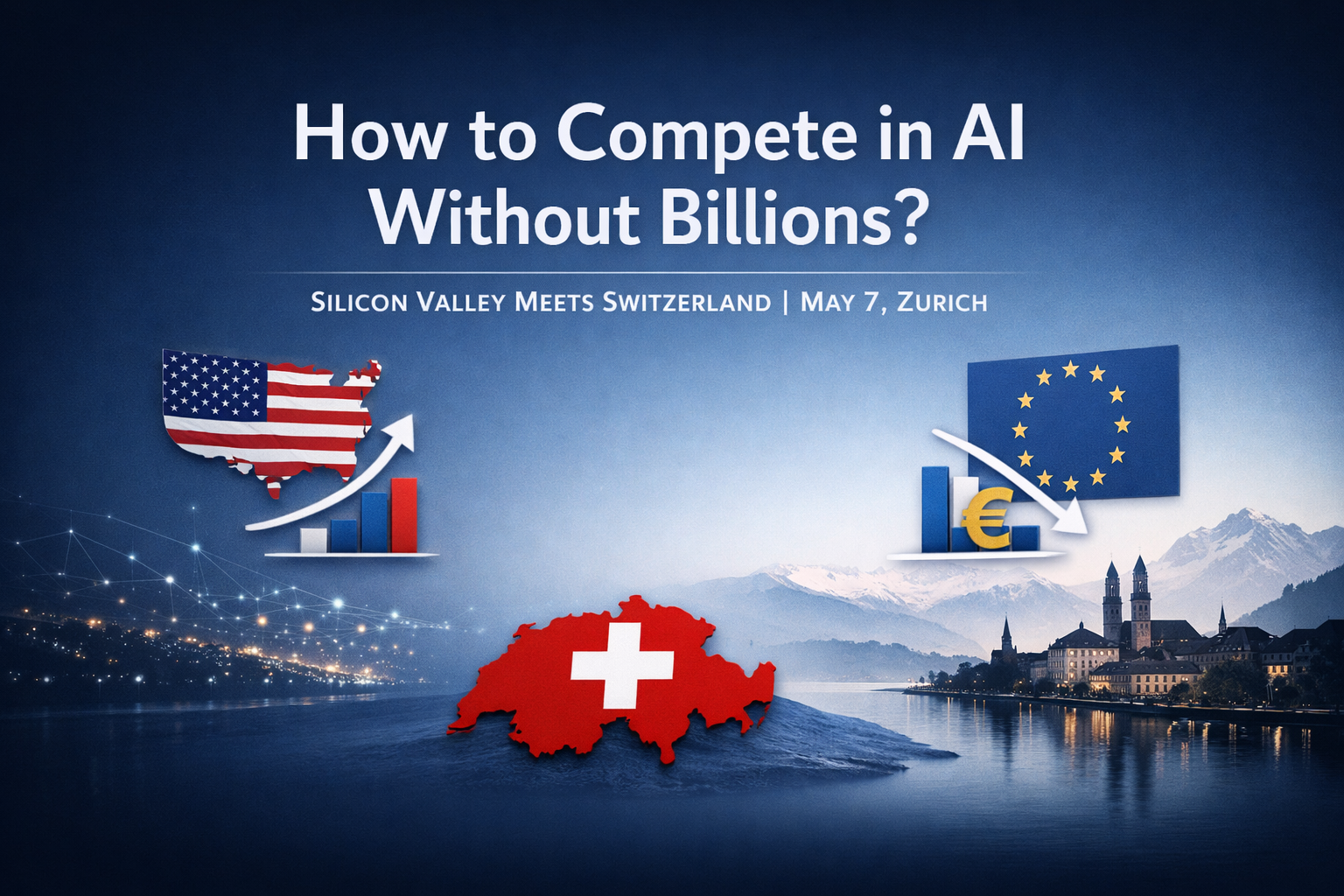
7. What Europe Must Understand
While the US and China are:
- building AI infrastructure
- deploying massive capital
… Europe is still largely focused on:
- regulation
- risk mitigation
- governance
👉 The issue is not regulation itself.
👉 The issue is lack of execution and scale.
Europe risks missing not just:
- model development
But the entire industrial value chain of AI.
Final Thought: The Industrialization of Intelligence
The key takeaway from GTC is not a product.
It is a shift:
Intelligence is being industrialized.
- produced
- scaled
- distributed
- embedded into systems
Companies that understand this will build:
- not AI features
- but AI-native business models
Those that don’t:
- will become part of someone else’s cost structure
High-Tech Connect Perspective
For Switzerland and Europe, the question is:
👉 Do we want to be users of AI?
👉 Or builders of its infrastructure and applications?
Our position at High-Tech Connect:
- focus on AI in the real economy
- build application leadership
- connect:
- industry
- data
- decision-making
Because the next phase belongs not to those who talk about AI—
👉 but to those who deploy it into real systems.









.jpg)


.jpg)


