


For more than 25 years, the Gartner Hype Cycle has been one of the most widely used frameworks in technology strategy.
It became the standard chart used by enterprises, consultants, analysts, universities, and investors to explain how new technologies evolve:
from excitement, to disappointment, to eventual productivity.
And for a certain era, it was useful.
Especially in the world of:
- ERP systems,
- CRM software,
- middleware,
- virtualization,
- and traditional enterprise IT adoption.
But the world has changed.
Today’s technology waves no longer behave like slow-moving enterprise software cycles.
Artificial Intelligence, robotics, EVs, semiconductors, quantum computing, synthetic biology, defense tech, and space technologies follow entirely different dynamics.
Yet much of Europe still analyzes them using frameworks built for a previous era.
That is increasingly becoming a strategic problem.
The Problem with the Gartner Hype Cycle
The Gartner Hype Cycle assumes that technologies move in relatively linear phases:
- Innovation Trigger
- Peak of Inflated Expectations
- Trough of Disillusionment
- Slope of Enlightenment
- Plateau of Productivity
The implicit assumption:
technologies are mostly driven by perception and enterprise adoption timing.
But modern technology ecosystems are driven by something very different.
Today, technological dominance is increasingly shaped by:
- infrastructure,
- compute power,
- capital intensity,
- ecosystems,
- platform effects,
- geopolitical competition,
- talent concentration,
- and scaling speed.
In many cases, “hype” itself is no longer irrational noise.
It becomes fuel for acceleration.
Capital attracts talent.
Talent attracts ecosystems.
Ecosystems attract developers.
Developers attract platforms.
Platforms create dominance.
This is precisely what happened with:
- NVIDIA,
- OpenAI,
- Tesla,
- SpaceX,
- BYD,
- and the hyperscalers.
The technologies did not collapse into a deep “trough.”
They scaled aggressively because infrastructure, capital, and demand already existed.
Europe’s Strategic Misunderstanding
One of Europe’s biggest mistakes over the last two decades has been repeatedly confusing:
“overhyped”
with
“strategically inevitable.”
While Europe debated risks and regulation,
the United States and China focused on:
- scaling,
- infrastructure,
- ecosystems,
- and market capture.
The result is visible almost everywhere:
- cloud,
- smartphones,
- semiconductors,
- AI platforms,
- EV ecosystems,
- hyperscale compute,
- social media,
- and increasingly robotics.
The classic Hype Cycle no longer explains these realities.
And yet it is still widely taught at universities and used in corporate strategy discussions.
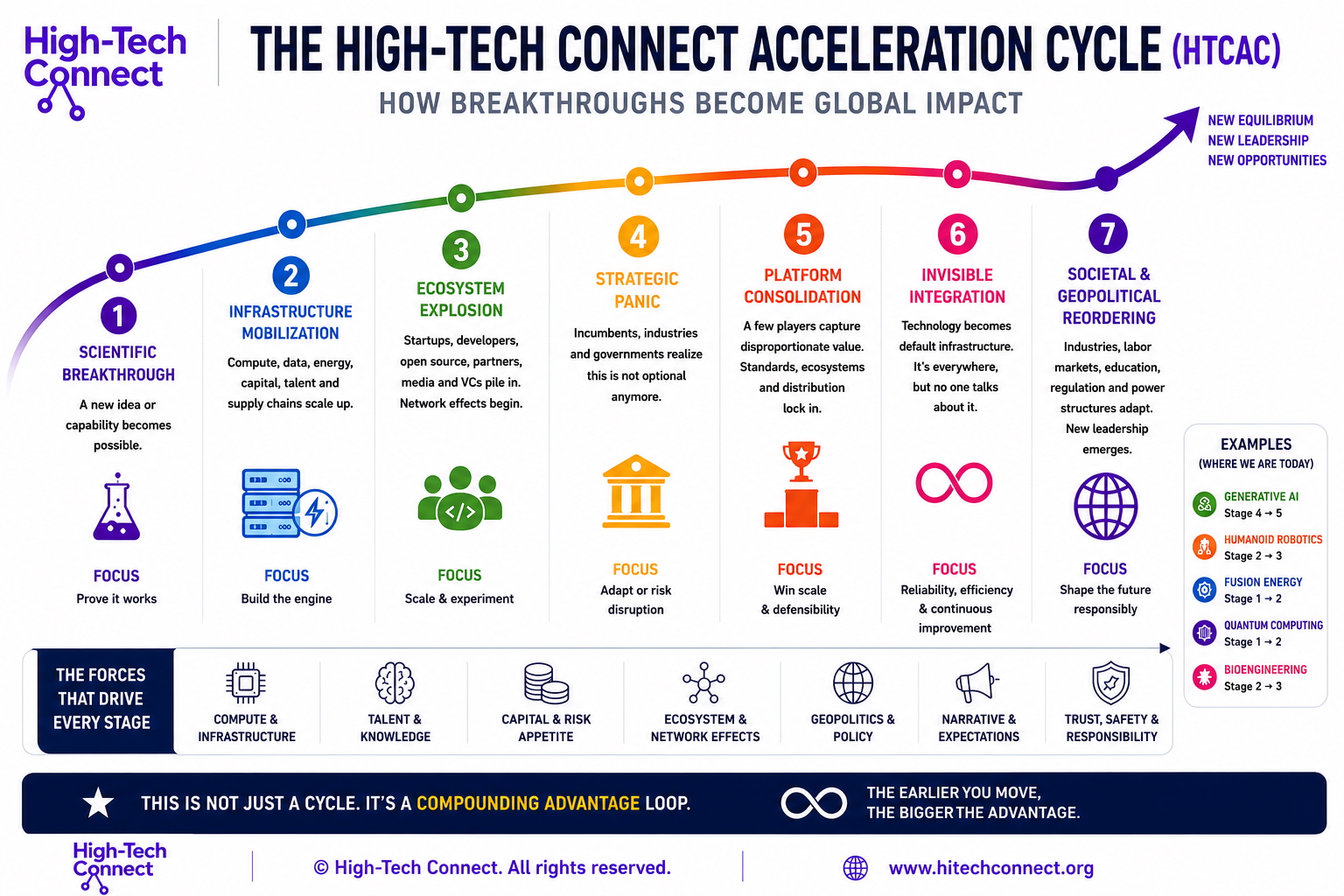
Introducing the High-Tech Connect Acceleration Cycle (HTCAC)
To better explain how modern technologies actually evolve, scale, and reshape industries, we developed a new framework:
The High-Tech Connect Acceleration Cycle (HTCAC)
Unlike traditional hype-based models, the HTCAC focuses on:
- acceleration,
- ecosystem formation,
- infrastructure mobilization,
- and compounding strategic advantage.
The key insight:
Modern technologies no longer evolve linearly.
They compound through infrastructure, ecosystems, capital, and geopolitics.
The 7 Phases of the HTC Acceleration Cycle
1. Scientific Breakthrough
A core capability becomes possible.
Examples:
- transformers,
- CRISPR,
- reusable rockets,
- fusion breakthroughs.
At this stage, the technology still looks experimental.
2. Infrastructure Mobilization
The engine gets built.
This includes:
- compute,
- energy,
- supply chains,
- capital,
- manufacturing,
- and talent pipelines.
This phase is massively underestimated in Europe.
3. Ecosystem Explosion
Startups, developers, researchers, open-source communities, media, enterprises, and investors pile in.
Network effects begin accelerating adoption.
Momentum becomes visible.
4. Strategic Panic
Governments and incumbents realize:
this is no longer optional.
The conversation shifts from:
“Is this real?”
to:
“How fast can we adapt?”
This is where many European industries currently are with AI.
5. Platform Consolidation
A small number of players capture disproportionate value.
Standards emerge.
Distribution locks in.
Platforms dominate ecosystems.
This is where hyperscalers and AI foundation model providers are rapidly moving today.
6. Invisible Integration
The technology becomes default infrastructure.
Nobody talks about it anymore because it becomes embedded everywhere.
Examples:
- the internet,
- cloud computing,
- smartphones,
- GPS.
AI will eventually reach this stage too.
7. Societal & Geopolitical Reordering
Entire industries, labor markets, education systems, and power structures adapt around the technology.
New leaders emerge.
New dependencies form.
New geopolitical balances appear.
This phase is almost entirely absent from traditional technology adoption frameworks.
Why This Matters
The HTC Acceleration Cycle is not just another chart.
It changes how leaders think about:
- investment timing,
- industrial policy,
- startup ecosystems,
- infrastructure,
- education,
- and strategic competitiveness.
Most importantly:
It explains why waiting is often no longer the safe option.
In exponential technology markets:
the earlier ecosystems scale,
the harder they become to catch.
The New Strategic Reality
Modern technology waves are no longer primarily driven by enterprise IT adoption cycles.
They are driven by:
- compute,
- ecosystems,
- capital,
- geopolitics,
- and speed.
Or more simply:
This is no longer a Hype Cycle.
It is a Compounding Advantage Loop.
And the countries, companies, and ecosystems that understand this first will likely define the next decades of global leadership.
(c) High-Tech Connect. All rights reserved.
www.hitechconnect.org













.jpg)


.jpg)


